








Map the published sequence before opening the chart
Give each accepted frame a stable name and record the actual order. Note where the product explanation, relationship label and link appear. A report grouped only by publication date can combine unrelated frames or miss a sequence that crosses a reporting boundary.
The engagement-rate guide starts with the definition of a percentage. For Stories, first identify what was measured on each frame. A sequence cannot be assessed coherently when one row contains views and another contains a differently defined audience count.
Retain the original provider or account labels, observation times and any available metric definitions. A polished slide should not hide the distinction between an action count and a viewing count.
Navigation is an action record
A provider may distinguish forward, back, movement to another account’s Story and exits. Sprinklr’s glossary describes these as different navigation measures. Check the dictionary for the actual tool and export rather than assuming that similarly named fields are interchangeable.
A backward action can justify inspecting whether the frame was useful or hard to read. It does not establish either motive. A forward action can likewise reflect a quick reader, repetition or loss of interest. Watch the actual frame before changing the creative.
Do not treat an old field name as proof that the metric is still collected the same way. Provider glossaries can mark measures deprecated. Keep the source and collection date beside the exported result.
Build a small sequence review
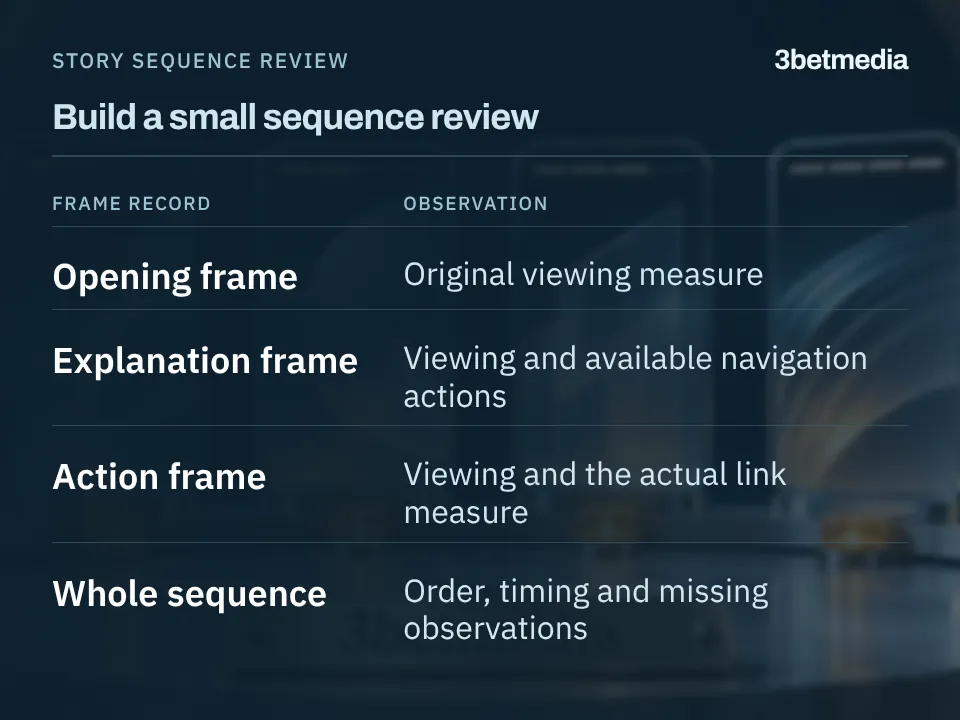
| Frame record | Observation | Production question |
|---|---|---|
| Opening frame | Original viewing measure | Does it establish the right question? |
| Explanation frame | Viewing and available navigation actions | Is a necessary detail hard to follow? |
| Action frame | Viewing and the actual link measure | Is the next step understandable? |
| Whole sequence | Order, timing and missing observations | Can these rows be compared? |
A creator content commission can change the frame order or explanation after review. Specify the actual production change. Asking a creator to improve retention without naming the frame or evidence gives them little useful direction.
Keep missing observations visible. Later’s collection guidance illustrates why a provider may have a narrower Story reporting window than the buyer expects. A blank export field should not quietly become a zero.
Talk to us
Pick a 30-minute slot, or DM us on Telegram.
Define a frame-level production change without promising a retention percentage.
Pricing is scoped to your brief. We reply within one working day.
Use an end/start ratio with a narrow label
If compatible records permit a last-frame count divided by a first-frame count, state the exact numerator and denominator. Call it an end/start ratio unless the underlying source supports a more specific measure.
That calculation alone does not establish that the same people watched every intervening frame. Some viewers may enter later, return or interact more than once, depending on the metric and surface. Avoid turning aggregate frame data into a person-level completion claim.
An illustrative sequence with 100 opening-frame views and 60 last-frame views yields a 60% ratio under those supplied labels. It does not prove that 60 identified people completed the full sequence. These values are invented arithmetic, not a benchmark.
Inspect the transition the data identifies
Suppose a fictional sequence changes from a product demonstration into a dense terms frame. The reviewer notices a change in the available navigation pattern there. The sensible next step is to inspect legibility, duration and the amount of information presented.
The responsible reviewer might approve a simpler visual treatment while preserving necessary terms. That is a production hypothesis for another commission. The report should not announce that a particular clause caused viewers to leave.
Keep the proposed change and observation in the campaign post-mortem. Retain which version the team inspected so the next review can distinguish a new edit from a changed reporting window.
Buy a useful sequence rather than a headline percentage
Bring the published frames and compatible owner-supplied records to the review. Decide which part of the sequence deserves a different treatment, what must remain accurate and what evidence the next order will retain.
The result can be a clear editing instruction even when the sample is small. State the uncertainty openly. A carefully scoped production decision is more valuable than a precise-looking percentage built from incompatible counts.
Frequently asked questions
Does a tap back prove someone liked a Story?
No. It records an action under the provider’s definition. Inspect the frame and context before interpreting why the action occurred.
Can last-frame views establish a completion rate?
Only use the claim supported by the underlying measures. An aggregate end/start ratio alone does not establish that the same people watched every frame.
Why can a Story export have missing fields?
Collection windows, account access, integration state and metric availability can differ. Preserve the limitation and consult the actual provider’s current documentation.
Results from campaigns our team has run
Web3 game · gaming creators, streams and events
Illuvium
6,550 new players and 24,000+ followers
Read the Illuvium caseCrypto exchange · KOLs on X, YouTube and TikTok
Binance
4,245 new users and more than $510M in trading volume, double the target
Read the Binance caseCrypto banking · influencers and growth
Swissmoney
32,000+ users onboarded and CPA cut 4x
Read the Swissmoney case
3betmedia launched in 2026; most of these campaigns ran before the name existed. See all 19 cases.
Sources and further reading
The decision aids and fictional examples are original production guidance. Primary references support their stated platform or policy facts. Actual permissions, applicable rules and campaign outcomes need their own evidence and responsible review.