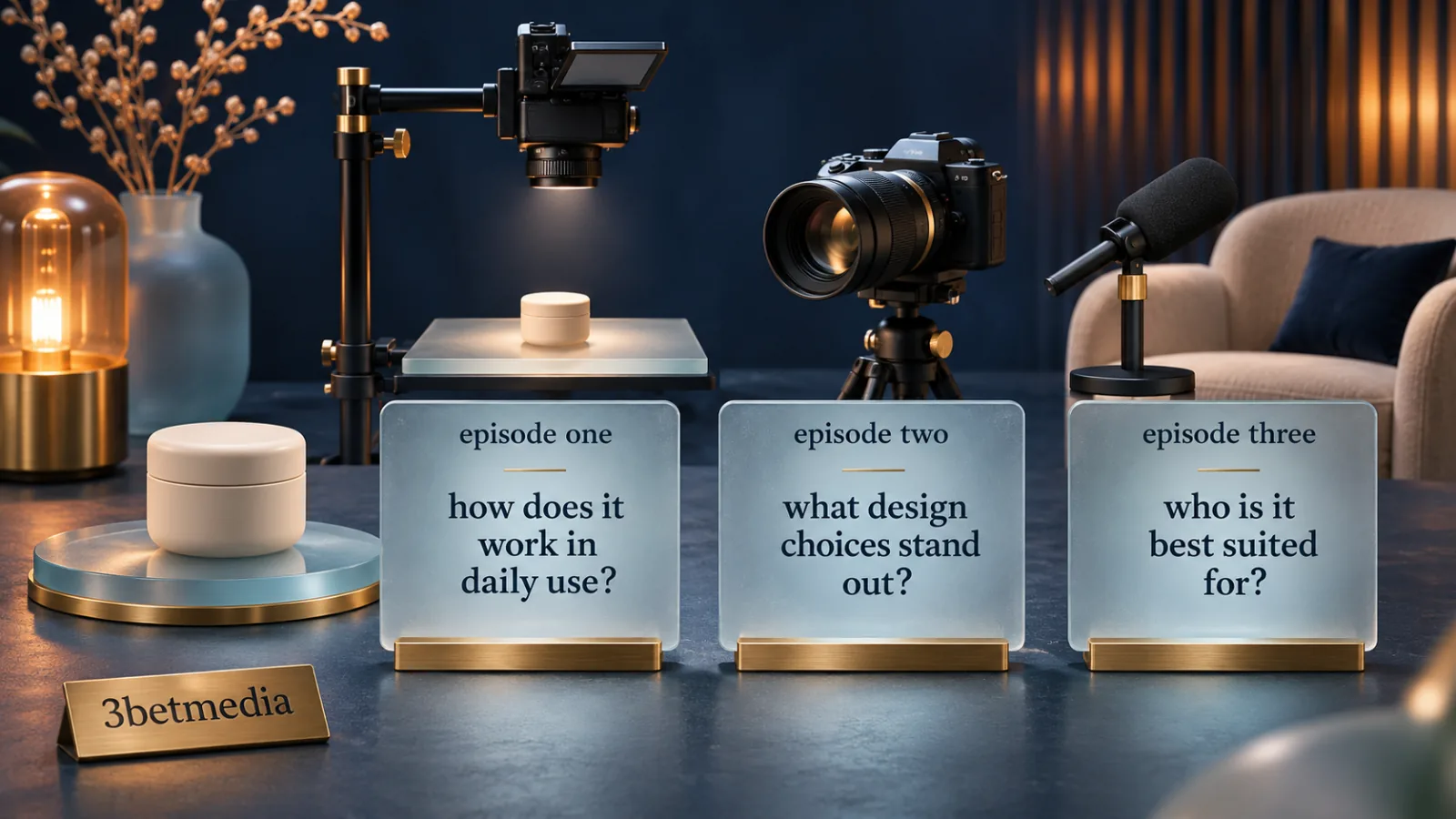








Map the questions before counting deliverables
List the product questions the brand can substantiate. A viewer might need to understand what arrives, how a supported feature works and which limitation affects their use. Keep the questions distinct enough that each video earns its own commission.
Use actual product, support or audience inputs where available. Label an untested idea as a proposed question, not proven demand. Do not invent customer confusion or a conversion problem to justify the asset count.
The product-demo and testimonial distinctions guide helps match the performer with the claim. A demonstration and a personal experience require different evidence even when they sit in one series.
Let each episode stand on its own
A person may encounter the third video before the first. Include enough product identity and context for the explanation to make sense independently. Do not rely on an earlier episode to supply a qualification needed by the current claim.
Write what the episode should answer and what it deliberately leaves to another asset. That boundary helps the creator avoid repeating the whole product introduction before every useful point.
Where a sequence matters, make its relationship understandable at the intended destination. A production plan can define an order; it cannot guarantee the order in which a social audience watches.
Use an episode map with separate acceptance rows
| Episode task | Source input | Accept when |
|---|---|---|
| Explain the included product | Confirmed sample and current contents | The opening accurately identifies what the viewer sees |
| Demonstrate one feature | Supported version and approved access | The action and relevant conditions remain clear |
| Address a limitation | Product owner’s verified boundary | The explanation preserves that limitation honestly |
This is an invented structure, not a prescribed three-video package. Remove an episode when it adds no separate answer. Add another only when a useful task and supporting evidence justify it.
Talk to us
Pick a 30-minute slot, or DM us on Telegram.
Bring the episode map and current product material to a UGC series call.
Pricing is scoped to your brief. We reply within one working day.
Choose creators by the work, not the desire for variety
One creator can provide continuity if they can perform the required demonstrations honestly. Several creators may suit different languages, formats or expertise. Compare those needs before spreading a simple explanation across a large cast.
Keep the product facts consistent without forcing identical opinions. A brand may supply a feature statement; it should not supply a fictional customer experience for every performer to repeat.
Agree creator version and usage rights for each destination and edit. A multi-episode order does not automatically grant unlimited reuse of every raw take, voice or soundtrack.
A fictional series removes a redundant episode
A buyer initially requests four product videos. During briefing, two proposed episodes both explain the same navigation action using the same source. The team combines that work and identifies a separate supported limitation the audience needs to understand.
The revised map gives each accepted asset its own task and reviewer. It does not replace a duplicate with an invented testimonial or assert that the revised series will produce better sales. This is an illustrative production decision, not a measured result.
If the fourth task lacks evidence, the team can narrow the commission rather than manufacture content to preserve the original count.
Review the series as related assets, not one giant metric
Check each final file and the relationships between them. A changed product fact may affect several episodes, while a single editing error may affect only one. Keep the source version and accepted correction connected to the actual assets.
YouTube’s unique-viewer guidance explains why per-video audience estimates can overlap. Do not add episode audiences and call the sum different people educated by the series. Delivery, viewing and understanding remain distinct questions.
Bring the episode map to UGC series coordination. Purchase a set of useful answers, with a clear finish for every video and an honest limit on what its report can establish.
Frequently asked questions
Does repeating one testimonial create a useful UGC education series?
Give each episode a separate supported product question. Repetition may be an intentional creative choice, but it should not masquerade as several distinct explanations.
Will viewers always watch the episodes in the planned order?
Do not assume that. Preserve essential identity and qualifications in each asset, and design the actual destination for any sequence the task requires.
Can we add every episode’s unique viewers into one series audience?
Not as a deduplicated audience without compatible measurement. Per-video estimates can contain some of the same people.
Results from campaigns our team has run
Solana community brand · KOLs on X
Retardio
15M+ impressions on X
Read the Retardio caseWeb3 game · gaming creators, streams and events
Illuvium
6,550 new players and 24,000+ followers
Read the Illuvium caseMove-to-earn app · creators on X and YouTube
STEPN
5,344 new users and 949 NFTs sold
Read the STEPN case
3betmedia launched in 2026; most of these campaigns ran before the name existed. See all 19 cases.
Sources and further reading
The episode map and fictional series are original commissioning recommendations. YouTube supports the bounded warning about overlapping per-video audience estimates. No automatic learning sequence, sales lift, unique-reach total or client result is claimed.
- YouTube: estimated unique viewers across videos
- 3betmedia: product demonstration and testimonial evidence