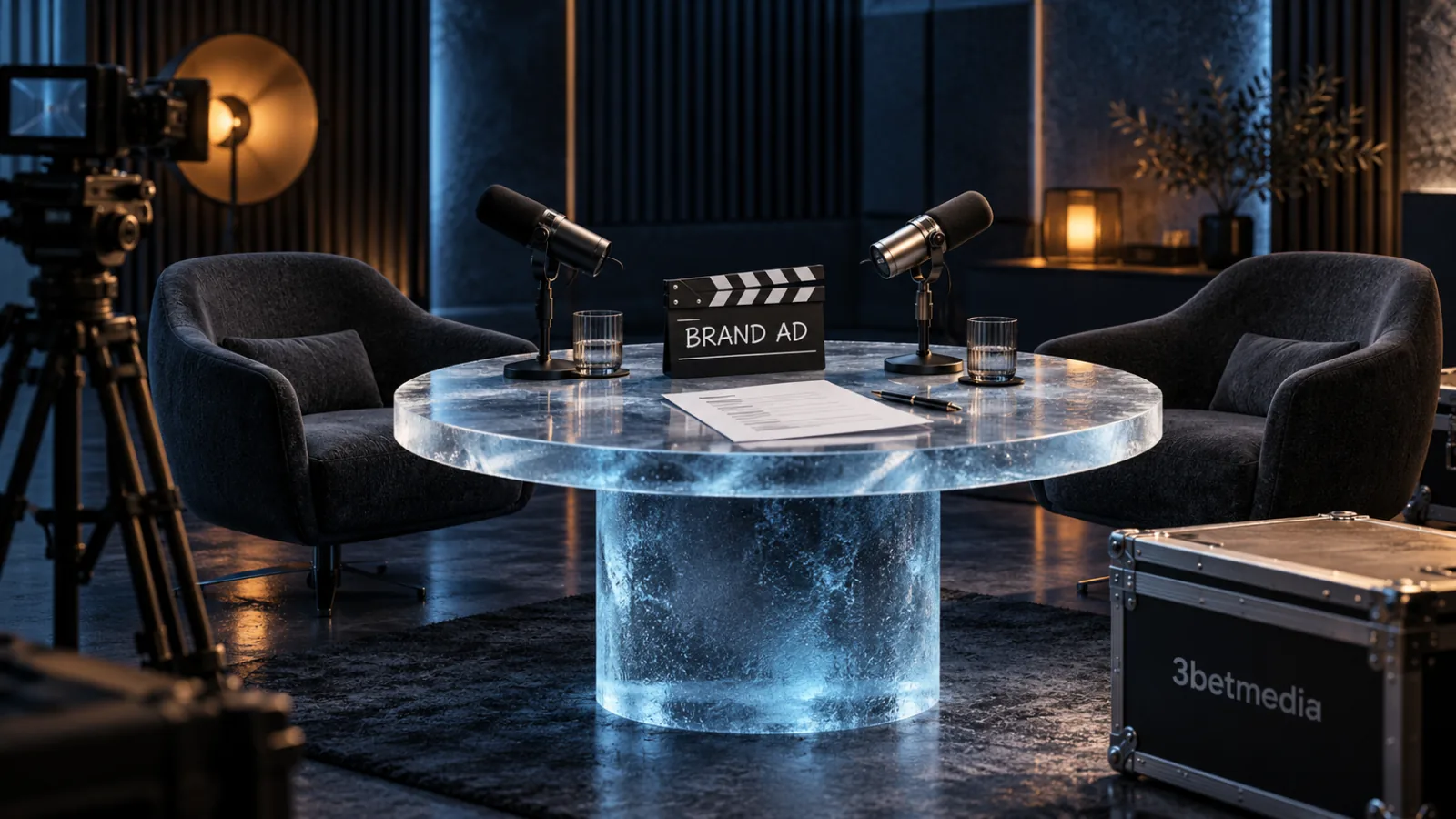








Buy a brand-owned recording, not an imaginary audience
Podcast-style UGC uses the visual language of a conversation: microphones, an interviewer and a reply. The deliverable can be a short advertisement filmed solely for the brand. It need not come from a published podcast, and it does not include a show's listeners merely because the set looks familiar.
This guide is for brands hiring creators, not people seeking UGC jobs. Decide whether you need one performer answering an off-camera question or two visible speakers. Name who supplies the interviewer; a quote for one creator does not silently include a second person's work.
The UGC creator management service covers sourcing, briefs, rights and delivery. Discuss the recording arrangement and intended use before assuming studio access, a particular creator or media placement is available.
Cast the exchange, not just a convincing solo read
Ask to see an appropriately permitted conversational sample. Listen for a complete answer, a natural pause and a response to the other person's words. A strong direct-to-camera reel does not show whether someone can hold a useful exchange without talking over the next line.
For two speakers, review a short joint sample or agree a paid test when new work is needed. Identify who asks the question, who explains the product and whether either person speaks from genuine experience. Existing chemistry can help a recording, but friendship is not evidence of product use.
State the product category before casting. A creator who accepts ordinary app work may decline casino or crypto promotion. Confirm suitability and the intended market individually. Do not ask performers to deposit money, gamble or buy tokens to qualify for the shoot.
Put the conversation unit in the quote
Price a defined recording and delivery scope. Separate talent, the second speaker if needed, location, capture, editing and permissions. A batch of cutdowns can require more than one opening line: the replies must still connect to the questions in each version.
Use this buying worksheet to compare proposals. It describes production decisions, not a standard rate card or a promise of a particular turnaround.
| Decision | Specify before booking | Check on delivery |
|---|---|---|
| Speaker roles | One performer and an off-camera prompt, or two contracted speakers | The agreed people and roles appear |
| Conversation | Questions, factual answers and permitted improvisation | Each reply belongs to its actual question |
| Coverage | Wide view, individual angles and clean audio needed for edits | The editor can assemble the named cuts |
| Advertising context | Visible and spoken treatment for the intended placements | Each cut remains recognisable as advertising |
| Licence | People, channels, markets, term and permitted derivatives | Both performances have the necessary permissions |
| Changes | Correction window and treatment of new scripts or speakers | Open changes are identified rather than assumed free |
If your own editor will assemble the ads, use the raw-footage hiring guide to define the capture-only handoff. Ask for the files the edit needs, not an unspecified number of minutes.
Talk to us
Pick a 30-minute slot, or DM us on Telegram.
Bring the conversation outline and required cutdowns to a UGC hiring call.
Campaigns from $2,000, with 10% off your first. We reply within one working day.
Make the commercial setting obvious
The FTC's native-advertising guidance assesses the overall impression, including the format. A studio setting can suggest independent editorial discussion even if the words are factually correct. Do not add a fictional show logo, an invented episode reference or a claim that a host discovered the brand independently.
Plan a clear advertising treatment with the actual destination in mind. Review the first frame, the spoken introduction where needed and what remains after a crop. A disclosure in a long recording may disappear when the editor extracts a short reply.
A staged explanation and a customer testimonial also need different evidence. FTC guidance distinguishes obviously fictional dramatizations from testimonials but warns that actor portrayals can still mislead. If the brief requires someone's real experience, start with the testimonial speaker checks. Do not coach an actor to invent a customer history.
Record enough context for the edit
Give the producer the accepted questions and factual limits. Let the performers vary delivery without changing the product claim. If a phrase needs a qualification, capture it in the same answer rather than leaving the editor to find it somewhere else in the session.
Agree how the two voices will remain intelligible. Ask for a practical sound test in the proposed room and enough clean pauses to make the planned cuts. These are production requests to discuss with the crew, not a universal equipment specification.
For remote speakers, decide whether the finished ad will show a remote conversation. Do not edit separate recordings to imply a genuine shared interview that never happened. Keep the production treatment accurate, and obtain permission for both voices, likenesses and any requested synthetic use.
A hypothetical cut that changes the speaker's role
Suppose a consumer-app team books two performers for a clearly labelled demonstration conversation. One asks how a notification setting works. The other explains the approved setting and points to a supplied demo screen. Neither claims to be a long-term customer.
During editing, someone replaces the opening question with “How has this changed your daily routine?” The same factual reply now sounds like a personal endorsement. The buyer rejects that version because the question changes what the answer appears to establish, even though the spoken answer itself is untouched.
The editor restores the original question or requests a newly reviewed script and performance. The team records that decision against the cut, rather than treating approval of the source session as approval of every combination. This is a fictional acceptance example, not a campaign result.
Accept each cut and keep distribution separate
Check every contracted version for the correct question and answer, complete qualifications, audible speech, readable captions and the agreed advertising treatment. Use the creator approval workflow to record the exact file accepted and any unresolved changes.
For creator-posted endorsements, the FTC calls for clear material-relationship disclosure with the message. A brand-owned file, a post on a creator's account and permission to run ads through that account are separate purchases. Confirm the actual use rather than inferring it from a filming invoice.
For regulated products, obtain the appropriate market and platform review before distribution. An accepted performance does not approve a gambling promotion or an investment claim. Keep ad buying outside the creator-production scope unless separately agreed.
Bring the product, proposed speaker roles, conversation outline and intended placements to the hiring call. Those inputs let the team discuss casting and delivery without promising a roster, an invented average fee or results the recording cannot guarantee.
Frequently asked questions
Does podcast-style UGC include a placement on a real podcast?
Not unless the agreement names that placement. A brand-owned conversation video buys production and agreed usage rights. Access to a show's audience, feed or creator account is a separate scope.
Do both speakers need an agreement for a two-person UGC ad?
Confirm the production and usage permissions for everyone whose performance appears. Do not assume one creator's quote includes another person's filming, likeness or advertising rights.
Can an editor turn a staged UGC conversation into a customer story?
Only genuine, supported experience can underpin a customer account. Changing the question or removing the advertising context can alter what a reply implies, so review each finished cut rather than relying on source-session approval.
Results from campaigns our team has run
Solana community brand · KOLs on X
Retardio
15M+ impressions on X
Read the Retardio caseWeb3 game · gaming creators, streams and events
Illuvium
6,550 new players and 24,000+ followers
Read the Illuvium caseMove-to-earn app · creators on X and YouTube
STEPN
5,344 new users and 949 NFTs sold
Read the STEPN case
3betmedia launched in 2026; most of these campaigns ran before the name existed. See all 19 cases.
Sources and further reading
The production worksheet and example are original planning aids, not client results. FTC sources provide US guidance, not campaign approval or a substitute for market-specific review. Supplier examples establish a format only; this guide promises no creator availability, price or conversion result.